
Cannabis Businesses Weigh Bank Versus Credit Union for Banking Needs
Authored by cannabiscanadabuzz.com, 01 Nov 2026
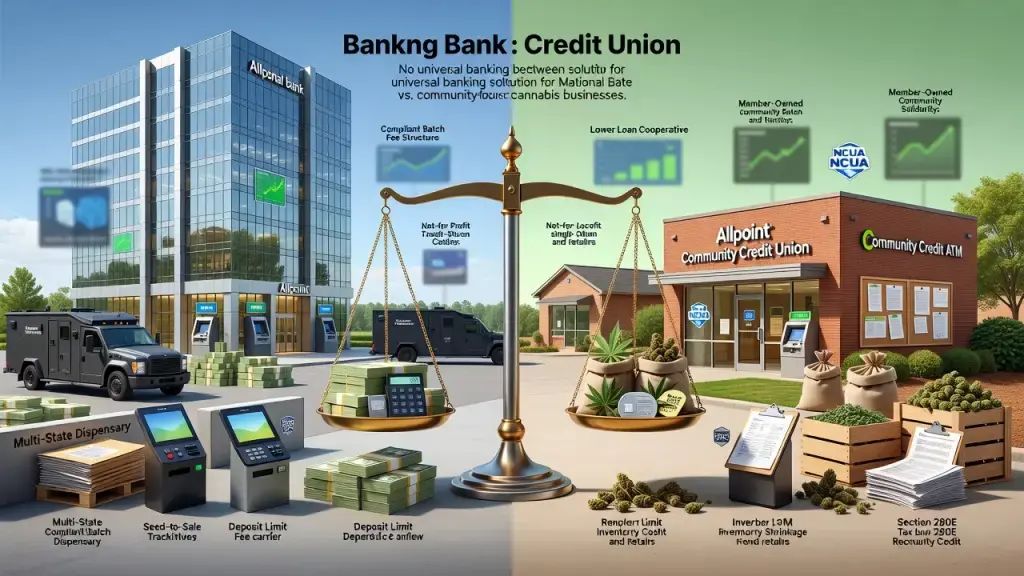
For a licensed cannabis operator, the choice between a bank and a credit union isn't just a personal-finance question - it's a business decision with real consequences for cash flow, compliance overhead, and day-to-day operations. Dispensary owners, cultivators, and ancillary suppliers already face a narrower pool of financial institutions willing to take cannabis-related deposits. Understanding the structural differences between banks and credit unions matters more here than in most industries, because the institution you choose shapes everything from loan terms to how quickly you can process payroll.
Not-For-Profit Versus For-Profit: Why It Matters More in Cannabis
The core distinction is simple enough: credit unions are not-for-profit, member-owned cooperatives, while banks are for-profit enterprises answerable to shareholders. In practice, though, this difference often plays out in deposit rates, loan pricing, and willingness to take on risk. Credit unions, tied to a specific community or membership group, sometimes offer more favorable terms on savings products and loans because they're not chasing quarterly profit targets. Banks, particularly larger national ones, tend to roll out digital tools and payment technology faster - a real consideration for operators managing point-of-sale systems, seed-to-sale tracking integrations, or multi-location inventory reconciliation.
That said, neither category is uniformly cannabis-friendly. Federal banking law still treats cannabis as a controlled substance, which means many credit unions and banks alike decline to open accounts for plant-touching businesses regardless of their nonprofit or for-profit status. The operators who do find banking relationships often pay higher account fees to offset the compliance burden the institution takes on.
Branch Access, ATMs, and the Cash-Heavy Reality of Dispensary Operations
Cannabis retail remains a largely cash-based business in many states, since federal restrictions limit access to major card networks. That makes branch and ATM access a genuinely operational concern, not just a convenience. National banks typically offer broader branch networks and cooperative ATM access. Credit unions may belong to shared ATM networks like Allpoint or participate in shared branching, but their footprint is often regional or tied to membership eligibility based on employer, location, or association.
For a dispensary handling daily cash deposits, limited branch access can mean longer transport times, higher armored-car costs, and increased inventory shrinkage risk if cash sits on-site longer than it should. Operators should ask directly about deposit limits, mandatory reporting thresholds, and whether the institution has experience servicing cannabis-adjacent accounts before assuming a smooth onboarding process.
Fees, Interest Rates, and the 280E Problem
Monthly maintenance fees, overdraft charges - often in the $30 to $35 range where still applied - and minimum balance requirements affect any small business, but cannabis operators feel them more acutely. Section 280E of the federal tax code already prevents cannabis businesses from deducting standard operating expenses, which compresses margins and makes every banking fee more consequential. A credit union's lower-fee structure can matter on a compliance log full of recurring costs; a bank's broader lending products might matter more to an operator seeking capital for expansion.
- Credit unions: community bond of association, often lower loan rates, limited branch footprint
- Banks: broader ATM and branch access, faster technology adoption, generally for-profit fee structures
- Both: federally insured up to applicable limits through NCUA or FDIC coverage
What Operators Should Prioritize
There's no universal right answer here. A multi-state operator managing payroll across several dispensaries may prioritize digital banking tools and nationwide access, favoring a bank relationship despite higher fees. A single-location retailer rooted in one community might find a credit union's lower rates and personal service more practical, assuming membership requirements can be met. The sharper question isn't which institution is objectively better - it's which one actually understands the compliance realities of cannabis banking and won't close the account six months in.