
Louisiana Attorney General Quietly Drops Out of Federal Cannabis Rescheduling Lawsuit
Authored by cannabiscanadabuzz.com, 04 Jun 2026
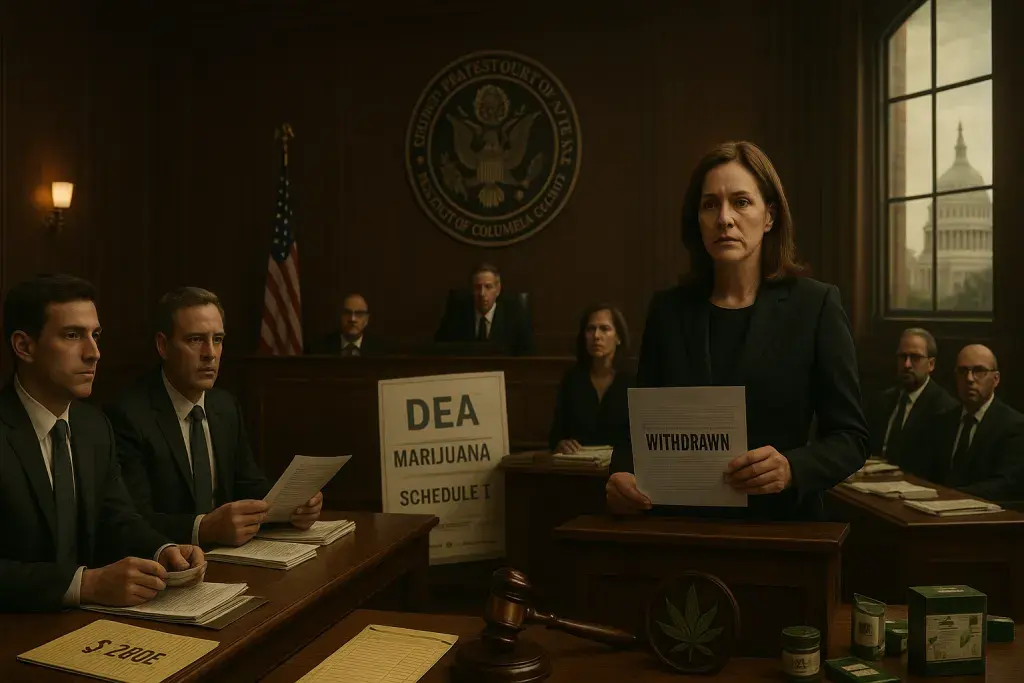
Louisiana Attorney General Liz Murrill joined a federal lawsuit in May challenging the Trump administration's cannabis rescheduling action - then withdrew just days later, offering no public explanation. The abrupt reversal adds an unusual wrinkle to already complicated litigation that now consolidates multiple challenges to the Drug Enforcement Administration's move to shift state-licensed medical cannabis products from Schedule I to Schedule III of the Controlled Substances Act.
For dispensary operators and compliance teams tracking the rescheduling fight, the uncertainty here is real. The outcome of these consolidated cases could affect how licensed cannabis businesses manage inventory classification, banking relationships, and tax exposure - particularly around 280E, the federal tax provision that has long prevented cannabis businesses from deducting ordinary business expenses. State-licensed operators from regulated markets like California, Illinois, and even markets where pos cannabis new york infrastructure is actively maturing have a direct stake in whether rescheduling survives legal challenge, since a Schedule III designation would represent the most significant shift in federal cannabis policy in decades.
What the Lawsuit Actually Claims
The case - originally brought by the attorneys general of Louisiana, Indiana, and Nebraska - argues that Acting Attorney General Todd Blanche's rescheduling order violated the Administrative Procedure Act and exceeded the statutory authority granted to the Attorney General under the Controlled Substances Act. The petitioners framed it as procedurally improper, arbitrary, and capricious. Standard administrative law language, but pointed in this context.
The court has since consolidated that complaint with a separate petition filed by Smart Approaches to Marijuana (SAM) and the National Drug and Alcohol Screening Association (NDASA). That second suit, signed by attorneys at Torridon Law - where former U.S. Attorney General William Barr is a partner - takes a similarly narrow procedural angle, arguing the rescheduling order fails on APA grounds and exceeds the AG's statutory authority. SAM had announced in January it was retaining Barr's firm specifically to fight rescheduling after President Trump signed an executive order directing officials to advance the process.
A third lawsuit, filed in late May by a coalition including anti-marijuana activists, substance use professionals, physicians, and a cannabis-focused biopharmaceutical company, has further crowded the docket. The consolidated proceedings are before the United States Court of Appeals for the District of Columbia Circuit.
Murrill's Exit Raises More Questions Than It Answers
What's striking here is the silence. Murrill's office has not explained why she joined the case or why she left it. Her withdrawal motion was terse - it noted that respondents did not oppose dismissal and asked that each party bear its own costs. That's it. No policy rationale, no statement to the press.
Political calculations around cannabis have become genuinely complicated in Republican-led states. Several red-state governors and attorneys general have found themselves balancing long-standing anti-drug positioning against the economic reality of operating medical cannabis programs that generate licensing revenue, sales tax receipts, and jobs. Louisiana has an active medical cannabis program. Whether that played any role in Murrill's decision to step back is unknown - but it's a fair question to ask.
What remains clear is that the two remaining state petitioners, Indiana and Nebraska, are still in the case. Both states have resisted legalizing any form of cannabis, medical or otherwise, which gives their challenge a different political texture than Louisiana's would have carried.
What Rescheduling Means - and Why the Legal Fight Matters
Under the April action announced by Blanche, marijuana products regulated under a state medical cannabis license immediately moved to Schedule III. Any marijuana products subsequently approved by the Food and Drug Administration would also carry a Schedule III designation. A broader administrative hearing, covering adult-use products, was scheduled for June.
The business implications of a durable Schedule III classification are significant. A Schedule III designation does not legalize cannabis under federal law - that matters, and operators should not misread the signal - but it does remove cannabis from the most restrictive federal category. More practically, it opens the door to revisiting 280E's application to cannabis businesses. That provision has cost licensed operators millions of dollars in excess federal tax liability over the years, effectively taxing gross revenue rather than net income. Any change there would restructure the economics of dispensary operations at a fundamental level.
There's also the banking angle. Rescheduling alone doesn't solve the access-to-banking problem that forces many dispensaries to operate as cash-heavy businesses, but it changes the federal risk calculus for financial institutions evaluating cannabis relationships. Payment providers and fintech firms operating in this space are watching the litigation closely.
Meanwhile, a House committee voted in May to block federal officials from taking further steps toward rescheduling - a legislative counter-move that adds yet another layer of uncertainty. Operators building five-year financial models right now are doing so with an unusually wide range of federal outcomes in play. That's the actual condition of the market: regulated, licensed, and operating under sustained legal ambiguity at the federal level.
For compliance teams, the practical advice hasn't changed. Continue operating under existing state licensing requirements, maintain rigorous seed-to-sale tracking and documentation, and monitor the D.C. Circuit proceedings as the consolidated cases develop. The rescheduling order is in effect - for now. Whether it survives judicial review is a different question entirely.