
Nigeria Customs Seizes Rifle Parts and Cannabis Products at Port
Authored by cannabiscanadabuzz.com, 10 Aug 2026
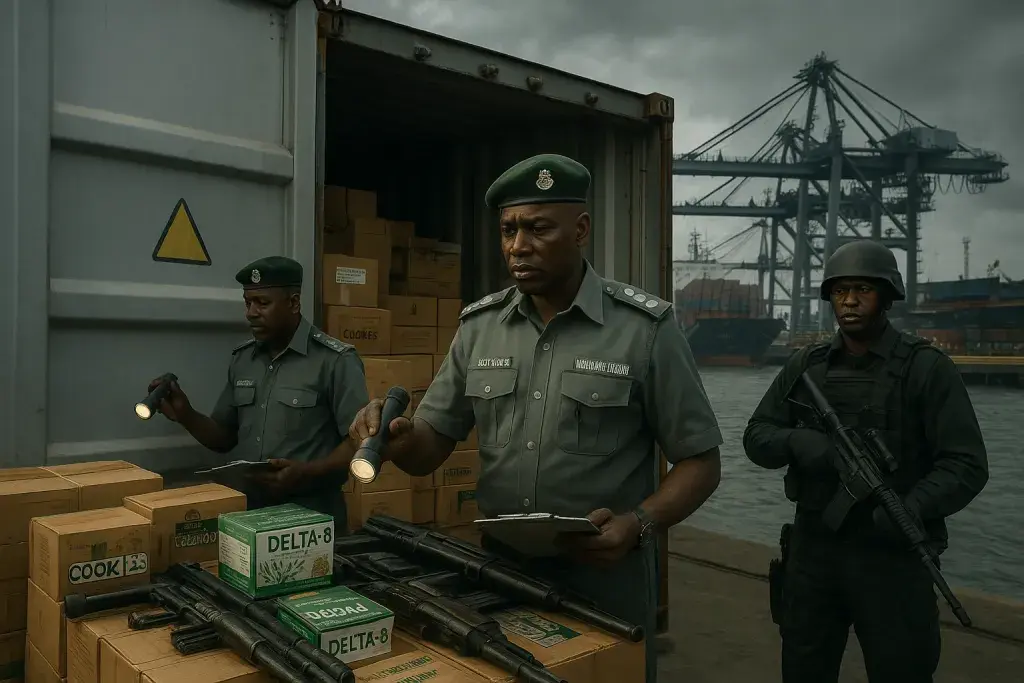
A single flagged container at Tincan Island Port has exposed how far smuggling networks will go to move contraband through legitimate trade channels. The Nigeria Customs Service (NCS) announced on Thursday, 6 August 2026, that it intercepted parts for more than 140 pump-action rifles disguised as ordinary cargo, alongside a separate haul of cannabis-infused products valued at over ₦373.8 million. Comptroller General of Customs Adewale Adeniyi framed both seizures as evidence of increasingly sophisticated efforts to exploit port infrastructure meant for lawful commerce.
The weapons parts arrived aboard MV VELIKA on 8 July 2026 and sat undetected until the Service's intelligence-driven risk management system flagged the container for closer inspection. That detail matters for anyone watching how regulated supply chains are policed globally, whether the product in question is firearms components or cannabis-infused goods. In jurisdictions where cannabis retail is legal, similar traceability logic underpins seed-to-sale systems: a compliant dispensary running a Metrc-integrated dispensary POS generates the same kind of digital paper trail that, in theory, makes diversion harder to hide. Nigeria's case shows what happens when no such tracking framework exists for a product entering the country at all - concealment becomes the default strategy, not the exception. Metrc-integrated dispensary POS
The cannabis seizure itself is instructive from a compliance standpoint, even outside Nigeria's borders where cannabis remains prohibited. Two 40-foot containers carried 109 cartons of Delta-8 cannabis-infused pre-roll cookies, 125 cartons of Delta-8 gummies, and 73 cartons of cannabis-infused cookies, tucked in among used vehicles, generators, and batteries. That packing strategy - burying regulated or prohibited goods inside unrelated freight - is a familiar smuggling pattern wherever cannabis products cross jurisdictional lines without proper licensing, lab testing, or import authorization.
Why Product Concealment Signals a Bigger Compliance Gap
In markets where cannabis is legally sold, products like Delta-8 pre-rolls and gummies move through tightly documented chains: cultivation batches get tagged, lab testing produces a certificate of analysis, and wholesale transfers are logged before anything reaches a dispensary shelf. Nigeria has no legal retail framework for cannabis-infused products, so there is no compliant path these goods could have taken. That absence of a regulated channel is precisely what makes concealment inside vehicle shipments and generator crates a rational, if illegal, choice for traffickers - there is no paperwork to forge because there is no system to forge it against.
For operators and suppliers in legal markets, the episode is a reminder of why lab testing, compliant packaging, and batch-level tracking exist in the first place. These aren't bureaucratic hurdles for their own sake. They are the mechanisms that let regulators, and eventually consumers, verify that what's in a package matches what's on the label - something entirely absent in the shipments seized at Tincan Island.
Security Concerns Ahead of the Election Cycle
Adeniyi connected both seizures to Nigeria's approaching general election, warning that ports and borders often see heightened smuggling activity around major political transitions. "We are about entering a major election cycle and we know that by this period, men of the underworld will want to use our borders, our ports, our airports to bring in items like this," he said, adding that the Service would "redouble" enforcement efforts.
He also addressed the possibility of internal compromise, stating that Customs "will not harbour" officials who might assist smugglers or use their positions to influence risky importations. Two suspects tied to the rifle parts have been arrested; a third remains at large. Adeniyi credited the Tincan Island Port Command and the Customs Enforcement Unit for the interceptions and encouraged the public to share intelligence that could support further enforcement.
What This Means for Trade Oversight Going Forward
- Intelligence-driven risk profiling, not random inspection, flagged the rifle-parts container before it cleared port.
- Concealment among unrelated goods - vehicles, generators, batteries - remains a persistent smuggling tactic for both weapons and cannabis products.
- No legal cannabis retail framework exists in Nigeria, meaning any cannabis-infused product entering the country does so outside any compliance system.
- Election-period enforcement is expected to intensify, with Customs signaling zero tolerance for internal collusion.
The dual seizure at Tincan Island is less about cannabis policy specifically and more about what happens when high-value, restricted goods move through ports lacking a legal, trackable pathway. Where regulated markets rely on tagged inventory and verified lab results to keep products accountable, unregulated smuggling relies on the opposite: obscurity, mislabeling, and volume shipments designed to overwhelm inspection capacity. Nigeria's Customs Service appears to be betting that better intelligence tools can close that gap before the next election cycle tests it further.