
Virginia Strikes Retail Cannabis Deal, Setting a 2027 Market Launch
Authored by cannabiscanadabuzz.com, 17 Jun 2026
Virginia has a path to a legal recreational marijuana retail market - finally. Gov. Abigail Spanberger, Sen. Lashrecse Aird, and Del. Paul Krizek announced Tuesday a compromise framework that would launch licensed adult-use cannabis sales on July 1, 2027, with the provisions folded into the state's pending budget. It's a significant reversal from last month, when Spanberger vetoed the General Assembly's legislation after lawmakers rejected her proposed amendments.
The deal puts Virginia in a familiar position for states building regulated cannabis markets from scratch: a compressed licensing window, a capped retail footprint, and a tax structure designed to grow over time. Operators in mature markets know this drill. States that have already worked through the structural questions - how to handle POS compliance, seed-to-sale tracking, and age-verification enforcement - offer useful precedent. Reviews of best cannabis pos systems maine and other established adult-use states show that technology infrastructure decisions made early in a market's life tend to compound, for better or worse, well into a retailer's operating years. Virginia's prospective licensees would do well to study those rollouts before February 2027 applications open.
A Capped Market With No Built-In Relief Valve
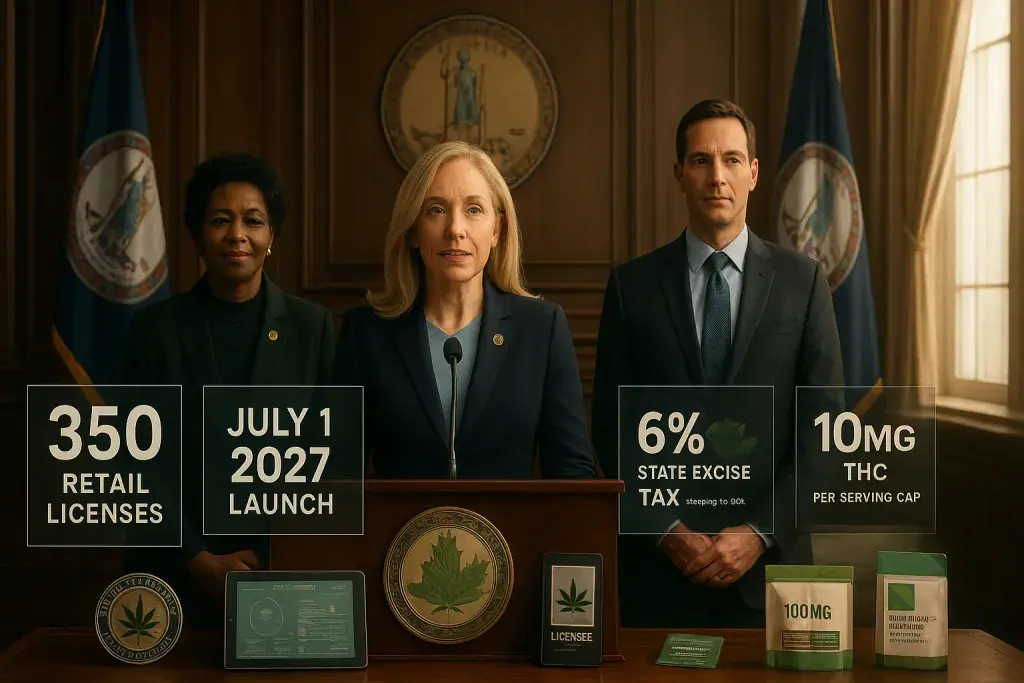
Three hundred fifty retail licenses. That's the ceiling - and unlike earlier versions of the legislation, this one locks the Cannabis Control Authority out of raising the cap unilaterally in the future. The CCA can start accepting applications on Feb. 1, 2027, roughly five months before the market opens.
Here's the catch: 350 stores spread across a state of roughly 8.7 million people is a tight distribution network by most adult-use standards. Operators in markets with similar or lower cap-to-population ratios have seen intense pressure on wholesale pricing, customer acquisition costs, and real estate values near compliant locations. The 1,000-foot buffer requirement from schools, playgrounds, hospitals, and drug treatment facilities will further concentrate viable retail footprints in specific corridors - something any prospective licensee needs to work through before signing a lease.
Current medical marijuana operators face a different calculation entirely. Those companies can enter the recreational market, but the price of that entry is steep: a $10 million fee to add adult-use sales. For vertically integrated medical operators already running cultivation, manufacturing, and retail under one roof, the math may work. For smaller medical license holders, it's a genuine barrier.
The Tax Structure Virginia Retailers Need to Model Now
The compromise sets a 6% state excise tax on cannabis products at launch, running alongside existing state sales and use taxes. That rate steps up to 8% after July 1, 2029. Localities can layer on an additional 1% to 3.5% on top of that.
To put it plainly: a Virginia dispensary in a municipality that applies the maximum local rate could be collecting close to 12% or more in combined cannabis-specific and local taxes - before the state's standard sales and use taxes are factored in. Operators building pro formas today need to model both the initial rate and the 2029 step-up into their unit economics. Wholesale menu pricing, retail margins, and competitive positioning against the illicit market all shift when the tax line changes mid-business-plan.
That last point matters more than it might seem. One of Spanberger's stated priorities was targeting the unlicensed market through clear enforcement and regulatory authority. High effective tax rates can work against that goal if licensed prices drift significantly above what unregulated sellers charge. It's a tension every adult-use state has wrestled with, and Virginia's phased approach at least acknowledges that the initial rate needs room to breathe.
Compliance Architecture and Small-Business Protections
The CCA will carry meaningful enforcement authority under this framework. Retailers that repeatedly sell to minors face license revocation - not a fine, not a warning letter, but the loss of the license itself. The CCA is also empowered to investigate ownership structures, audit financial ties between license holders, and create policies around control of licenses. That last piece signals that Virginia is building in anti-concentration measures from the start, consistent with the stated goal of keeping the market competitive for small businesses.
Krizek specifically called out protections for "impact licensees" - a term associated with social equity licensing - and microbusinesses. Whether those protections hold through the budget process and subsequent rulemaking is a separate question, but the intent is written into the compromise language.
On product safety, the framework caps THC at 10 milligrams per serving and 100 milligrams per package. Those limits align with restrictions seen in other adult-use states and will directly shape SKU development for manufacturers entering the Virginia market. Retailers stocking compliant inventory will need to verify that product batches meet those thresholds - which means COAs and lab testing documentation become operational requirements from day one, not afterthoughts.
The Hemp Redefinition Is the Near-Term Wildcard
One provision takes effect well before the 2027 retail launch: a redefinition of legal hemp products that drops the current 25:1 CBD-to-THC ratio requirement. That change hits Aug. 15 of this year. CBD retailers and hemp product sellers have already raised concerns that the revised definition could reclassify existing inventory as marijuana - making products that are currently legal to sell technically illegal until the recreational market opens.
For hemp-adjacent businesses, this isn't an abstract compliance note. It's a potential operational disruption that arrives in weeks, not months. Operators in that space should be reviewing current product lines against the incoming definition now and consulting legal counsel on inventory exposure before the August deadline.
The broader Virginia picture is one of a market being built carefully, if slowly. A 2027 launch is not fast - personal consumption and possession were legal here since 2021, and the gap between legalized use and licensed sales has let the unregulated market entrench. The compromise at least puts a firm date on the calendar, a licensing structure on paper, and an enforcement framework behind it. Whether the build-out matches the ambition is a question the next two years will answer.