
Elevate Cannabis Clears First Hurdle to Open Shrewsbury's Inaugural Adult-Use Dispensary
Authored by cannabiscanadabuzz.com, 06 Jul 2026
A Kansas City-based multi-site operator is pushing to bring recreational cannabis retail to Shrewsbury, Missouri - a municipality that legalized adult-use marijuana by constitutional amendment in 2022 but never finished updating its local ordinances to reflect that fact. On June 24, the Shrewsbury Plan Commission advanced both a zoning amendment and a special-use permit for Elevate Cannabis, which operates 15 dispensaries across Missouri under several retail brands. The full board of aldermen still must approve the ordinance revision, a rezoning request, and the permit before a single product hits a display case.
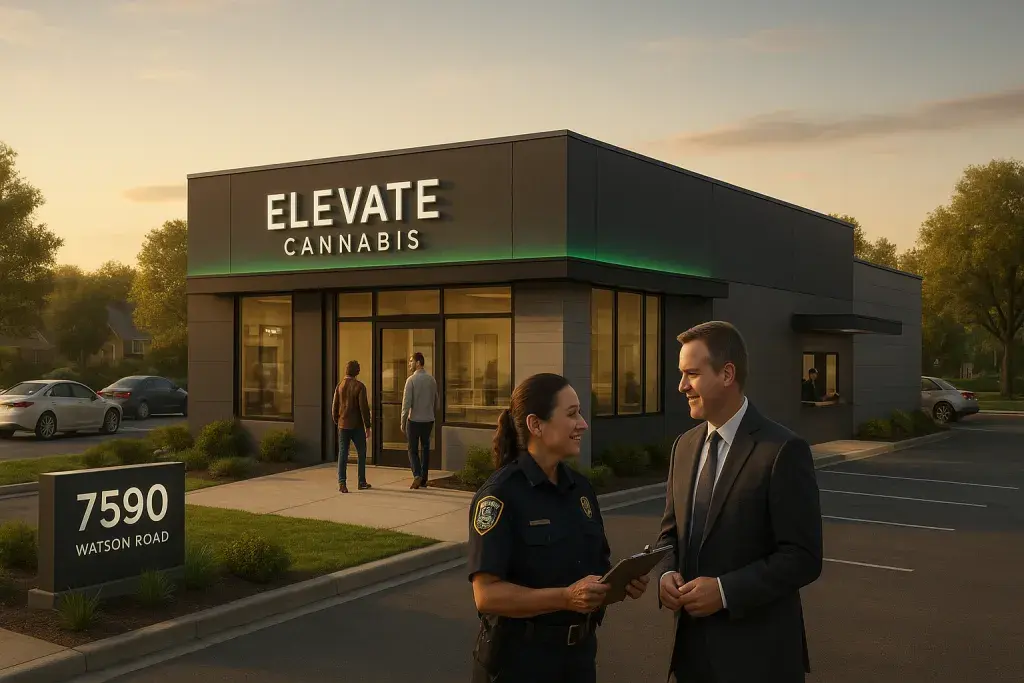
Elevate's proposed site at 7590 Watson Road - a ground-up, 2,800-square-foot build with 19 parking spaces - would incorporate an adjacent parcel at 7500 Watson Road, which itself needs separate rezoning to accommodate the business use. Because Missouri caps the total number of dispensary licenses in the state, Elevate isn't applying for a new license; it's proposing to relocate an already-licensed facility to the Shrewsbury address. That's a meaningful distinction. License caps create a secondary market for existing permits, and relocating a licensed facility rather than applying fresh requires a different regulatory pathway with the Missouri Department of Health and Human Services. For multi-site operators running store networks of this scale, retail infrastructure decisions - site selection, build-out specs, pick-up window logistics, and the underlying cannabis POS by IndicaOnline or similar platform that ties inventory, compliance reporting, and customer transactions together - are rarely simple, even when the license already exists.
The company's attorney framed the retail model plainly at the June 24 hearing: customers can shop on-site or order online and use a pick-up window, much like a pharmacy. That description maps onto how most compliant adult-use dispensaries in Missouri are structured - no on-site consumption, strict state-mandated security protocols, and age verification at every transaction point. Elevate's presentation projected roughly $1.6 million in annual tax revenue for Shrewsbury, which the company said would represent approximately 3% of the city's total budget. Those figures are projections, not guarantees, but the tax math matters to local officials weighing a new commercial use against neighborhood concerns.
The Ordinance Gap and What It Means for Operators
Here's the catch: Shrewsbury's failure to update its marijuana ordinances after Missouri's 2022 constitutional amendment isn't unusual, but it creates real friction for operators trying to enter a market. The city had passed an ordinance governing medical cannabis - a narrower regulatory frame - but never expanded it to cover adult-use. City Administrator Dustin Ziebold acknowledged the gap directly, attributing it to the simple fact that no cannabis businesses had tried to open there. In practice, though, that gap means Elevate can't operate under existing municipal code, which is why the ordinance revision is a prerequisite, not a formality.
The revised ordinance, drafted in alignment with Missouri state law, sets location restrictions relative to schools, child care facilities, churches, and libraries. The plan commission also added language restricting proximity to single-family residential zones. These buffer requirements are standard in regulated cannabis markets across the country - they're the local analog to state-level compliance requirements, and they add another layer of site-selection risk for operators. A location that clears state licensing criteria can still fail at the municipal zoning stage. Both lots at the Watson Road site are already under contract, which means Elevate is carrying real estate cost exposure while the regulatory process runs its course.
Law Enforcement's Response Signals Broader Industry Normalization
What's striking about the Shrewsbury process is the police chief's survey. Chief Lisa Vargas contacted 15 area law enforcement agencies operating near existing cannabis dispensaries and reported back to the board that the response was, in her words, "abundantly positive" - even from agencies opposed to legalized marijuana on principle. None reported increased crime or meaningful demand on police resources. Most said the businesses generated essentially no calls for service.
That's a data point worth keeping. For operators seeking municipal approval in markets where adult-use is legal but local sentiment remains divided, law enforcement feedback of this kind can be more persuasive to a board of aldermen than any financial projection. It reframes the conversation from ideological to operational. Dispensaries that run tight security protocols, maintain compliant point-of-sale records, and limit foot traffic friction tend to generate fewer neighborhood complaints - which, in turn, makes the permit renewal process considerably less contentious.
What Comes Next for Elevate and for the Market
The board of aldermen still holds final authority over three separate approvals: the updated marijuana ordinance, the rezoning of the secondary parcel, and Elevate's special-use permit. Any one of those three failing would stop the project. Multi-site operators know this arithmetic well - the licensing may be in hand, the real estate under contract, the build-out designed, and the tax projections delivered, but municipal approval processes move on their own schedule and with their own logic.
For the broader Missouri adult-use market, the Shrewsbury process reflects a pattern repeating across suburban and smaller municipalities: state law opened the door in 2022, but local regulatory infrastructure has been slow to follow. Operators targeting these markets are effectively doing dual compliance work - satisfying state licensing requirements while simultaneously shepherding local ordinance updates that, in some cases, the municipality itself had set aside. That's operational overhead that doesn't show up in the tax revenue projections.