
House Appropriations Committee Blocks Medical Cannabis From Federal Workers' Comp, Defying Rescheduling
Authored by cannabiscanadabuzz.com, 10 Jun 2026
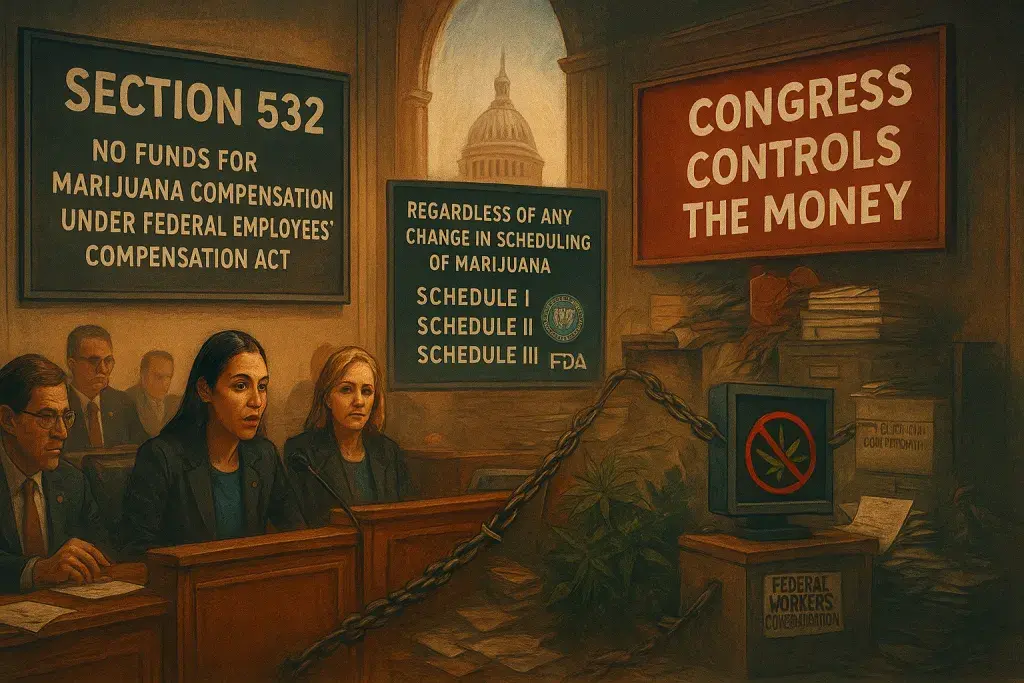
The House Appropriations Committee voted 34-28 on Tuesday to advance a Fiscal Year 2027 Labor-HHS spending bill that explicitly bars the Department of Labor from recognizing medical marijuana as a compensable treatment under any federal workers' compensation program - and it goes further than most expected. The prohibition holds "regardless of any change in the scheduling of marijuana" under the Controlled Substances Act, a direct legislative wall thrown up against the Trump administration's own April announcement that it was moving state-licensed medical cannabis and FDA-approved cannabinoid products from Schedule I to Schedule III.
The statutory language in Section 532 is tight and deliberate: no funds may be used to "authorize, provide, reimburse, or otherwise recognize marijuana or any cannabis-derived substance as a compensable medical treatment or benefit" under programs including the Federal Employees' Compensation Act. State-licensed operators who have built compliance programs, seed-to-sale tracking, and product documentation around the expectation that federal rescheduling would open institutional doors - insurers, employer benefit programs, and government procurement channels - got a pointed reminder this week that Congress controls the money, not the DEA scheduling calendar. For operators in regulated markets from Maryland to New Mexico, the practical takeaway is that the federal benefit structure remains walled off. Tools like a dispensary pos maryland system can document every patient transaction and generate compliant records, but the gap between state-level medical legitimacy and federal benefit recognition isn't a technology problem - it's a policy one, and Tuesday's vote made that gap wider on purpose.
What's striking here is the timing. The Trump administration's rescheduling move was, among other things, pitched as a signal of growing federal tolerance for state medical cannabis programs. The Schedule III proposal - now the subject of a hearing scheduled later this month - would lower certain regulatory barriers and, in theory, ease the 280E tax burden that crushes licensed dispensary operators by denying standard business deductions. But the Appropriations Committee vote suggests that at least one powerful corner of Congress is running a parallel track: let the executive branch adjust the scheduling, and then use the appropriations process to surgically prevent any practical consequence from flowing through federal programs. That's a sophisticated play, and operators should recognize it for what it is.
A Bill Full of Drug Policy Riders - and Their Operational Signals
The workers' comp provision doesn't stand alone. The same Labor-HHS bill includes a rider blocking funds for any activity that "promotes the legalization" of any Schedule I substance - language that has been embedded in federal spending legislation since the 1990s. Past attempts by Rep. Alexandria Ocasio-Cortez (D-NY) to strip that language, on the grounds that it impedes psychedelic research, have been defeated. It remains in the bill.
The committee report attached to the legislation also flags cannabinoid hyperemesis syndrome (CHS) - a condition associated with prolonged, high-potency cannabis use that produces severe nausea and vomiting - and instructs the CDC to complete a previously directed report on the issue. With high-THC vaping products occupying growing shelf space at dispensaries across adult-use and medical markets, this is the kind of regulatory signal that responsible operators and compliance teams should not file away. Consumer safety documentation, staff training on recognizing adverse-use patterns, and SKU-level potency transparency are not just best practices - they are increasingly the terrain on which regulators and legislators build the next round of restrictions.
The bill also prohibits funding for supervised drug consumption sites and places tight conditions on syringe exchange programs, while the attached report explicitly commends the Trump administration's shift away from harm reduction approaches. Rep. Madeleine Dean (D-PA) filed an amendment to remove much of that language; it was defeated on a voice vote.
The Rescheduling Hearing and the Legislative Pressure Around It
The broader Schedule III rescheduling process moves to a formal hearing later this month - and the committee activity this week makes the stakes clearer. Even if rescheduling proceeds, Congress has now demonstrated, in real legislative text, that it can carve out specific federal programs from any downstream effect. Workers' compensation is the first named exclusion. Drug testing is another: a separate spending bill the same committee approved last week directs federal agencies to continue testing government employees and safety-sensitive workers - truck drivers, airline pilots - for marijuana, "regardless of any future changes to the legal status or scheduling."
For multi-state operators and the investors behind them, the rescheduling hearing is still meaningful. The 280E tax issue, where licensed cannabis businesses are denied standard deductions because they handle a federally controlled substance, is widely expected to be addressed if Schedule III takes effect - and that has real financial weight for any operator running thin margins against high state excise taxes and overhead. But the Appropriations Committee's activity this week is a clear signal that the legislative branch views rescheduling as a DEA and FDA process it can hem in through spending riders. That's a compliance and business planning reality, not a hypothetical.
What Licensed Operators Should Watch Now
The committee's actions this week touch multiple pressure points that licensed cannabis businesses track closely. A few worth flagging:
- The workers' comp exclusion applies to federal employees and federal programs - it does not directly govern state workers' compensation systems, where medical cannabis reimbursement has already been litigated and, in some states, ordered by courts.
- The Schedule I promotion rider has been law for decades and primarily affects federal agency communications; it has not historically been used to prosecute state-licensed operators, but its continued presence limits federal agency flexibility on cannabis education and research funding.
- The CHS provision is a consumer safety marker. Regulators and legislative staffers are watching potency trends, particularly in vaping products and high-concentration ingestibles. Operators who treat potency labeling and staff consumer education as compliance checkboxes rather than substantive responsibilities should adjust that posture.
- The Homeland Security bill approved the same day directs Border Enforcement Security Task Forces to increase detection and investigation of illegal grow operations, specifically those tied to transnational criminal organizations and foreign nationals - a provision that underscores why licensed operators' compliance documentation, chain-of-custody records, and wholesale verification processes remain important market differentiators.
The thing is, the legislative picture on cannabis this week isn't simply pro or anti. It's fragmented in ways that create real operational uncertainty. Rescheduling may advance. Certain federal restrictions will be legislatively preserved regardless. State programs remain protected under the separate medical cannabis rider carried since 2014. And the consumer safety conversation - CHS, high-potency products, youth access - is gaining institutional traction in committee reports, which is often where the next round of regulation gets drafted. Licensed operators who are tracking only the rescheduling hearing are watching one thread in a much more tangled weave.