
Federal Hemp Ban Timeline Shifts Again, Leaving Retailers in Limbo
Authored by cannabiscanadabuzz.com, 13 Aug 2026
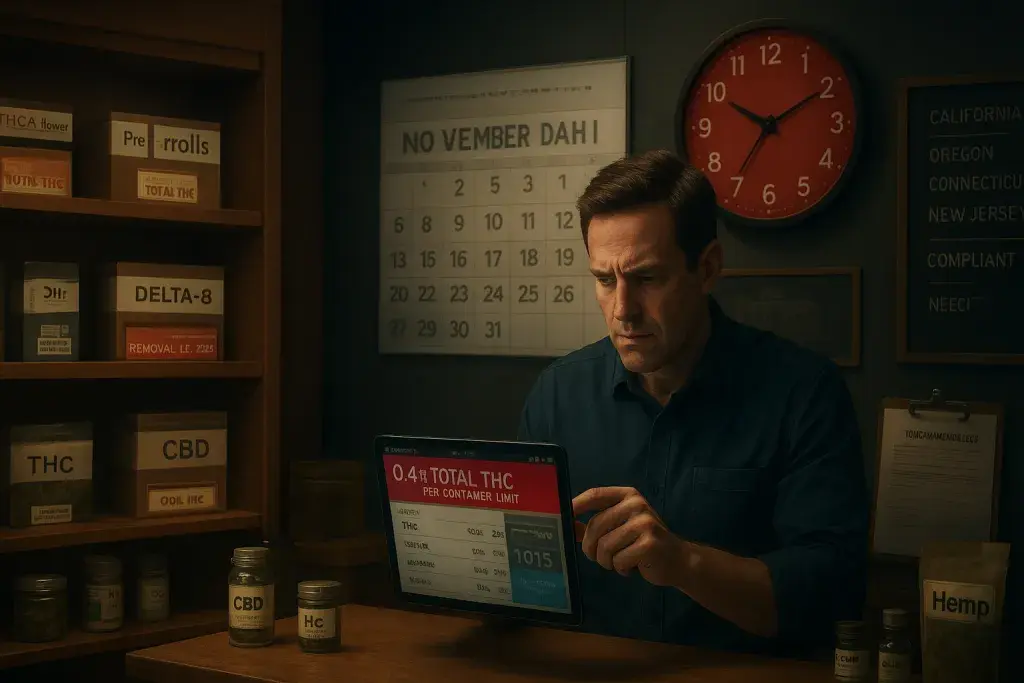
The federal hemp ban isn't a headline exercise anymore - it's a law already on the books, and the only real question left is when it bites. Congress signed a total-THC redefinition of hemp into law on November 12, 2025, with a one-year runway before enforcement. That runway just got a lot more complicated, and for dispensary operators and hemp retailers alike, the practical planning window is narrower than it looks.
Here's the mechanism, stripped of politics: the 2018 Farm Bill measured only delta-9 THC by dry weight, which left THCA flower, converted cannabinoids like delta-8, and a wide swath of intoxicating hemp products technically compliant. Section 781 of the FY2026 appropriations act closes that gap by counting total THC - delta-9 plus THCA - against a hard cap of 0.4mg per container on finished products. That single change reclassifies most of what's currently sitting on hemp shelves nationwide. Operators building out compliance infrastructure right now, including those evaluating cannabis pos systems south carolina, need software that can flag total-THC thresholds at the SKU level, not just delta-9 percentages, because the old testing logic won't hold past the effective date. cannabis pos systems south carolina
The Senate's early-August stopgap funding bill pushed most restrictions from November 12 to December 11, 2026 - but only for naturally derived cannabinoids. Synthesized ones, delta-8 and HHC among them, got no such reprieve and still face the original date. That bill still needs House passage and a signature before December 11 means anything. For any operator managing wholesale menus or budroom inventory that includes converted cannabinoids, that split date is the single most consequential detail in this whole cycle - not the topline "hemp ban" framing itself.
What Actually Changes on the Shelf
Three product categories take the direct hit. THCA flower, pre-rolls, vapes, and concentrates fail outright once raw THCA counts toward the total-THC calculation - most flower testing above 20% THCA lands nowhere close to compliant. Delta-9 gummies and beverages at typical dosing blow past the 0.4mg-per-container cap in a single unit, which reshapes edibles and drinkable formats regardless of how they were sourced. And delta-8, delta-10, and HHC products get excluded on a different basis entirely: they're synthesized outside the plant, so potency is irrelevant - they're out by definition, and out on the earlier date.
What survives is narrower than most retailers assume. Industrial hemp grown for fiber, grain, or seed is untouched. CBD products that stay under the 0.4mg cap remain viable. Everything else depends on FDA cannabinoid lists that Congress ordered but hasn't yet published, which leaves compliance teams working from an incomplete rulebook.
Why the Vote Split the Way It Did
The Senate tabled an amendment from Senator Ted Budd that would have killed the one-month delay and kept the November 12 date firm - that motion passed 61-32, with Majority Leader Thune and Minority Leader Schumer both voting to table. Twenty-one Republicans and eleven Democrats sided with Budd anyway. That's not a normal party-line breakdown, and it signals the debate isn't settled along the usual axes. Supporters of the faster timeline point to pediatric emergency-room data tied to intoxicating cannabinoid exposure; the hemp industry counters that it's spent years asking for the FDA framework - age gating, mandatory testing, potency caps - that lawmakers are only now considering as a fallback.
What Operators Should Actually Do
Waiting for Washington to finalize the calendar is not a compliance strategy. State law is the floor that applies regardless of what the House does with the stopgap bill, and it varies sharply - California's AB 8 pushes THCA into licensed dispensaries, Oregon and Connecticut have moved to total-THC testing standards, New Jersey has banned intoxicating hemp retail outright, and Texas enforcement is paused under a temporary restraining order. None of that changes when the federal definition shifts; it just determines what's available locally in the meantime.
- Audit current SKUs against total-THC standards, not delta-9 alone
- Separate synthesized cannabinoid inventory, which faces the earlier date
- Track state-level rules independently of the federal timeline
- Monitor Congress.gov directly rather than relying on secondhand coverage
The dates have already moved once. They can move again before December 11 arrives, and the House hasn't voted. Treat this as a live compliance risk with a moving deadline, not a settled fact - because right now, it's genuinely both.