
Senate Rebuffs Budd's Push to Speed Up Hemp Product Crackdown
Authored by cannabiscanadabuzz.com, 13 Aug 2026
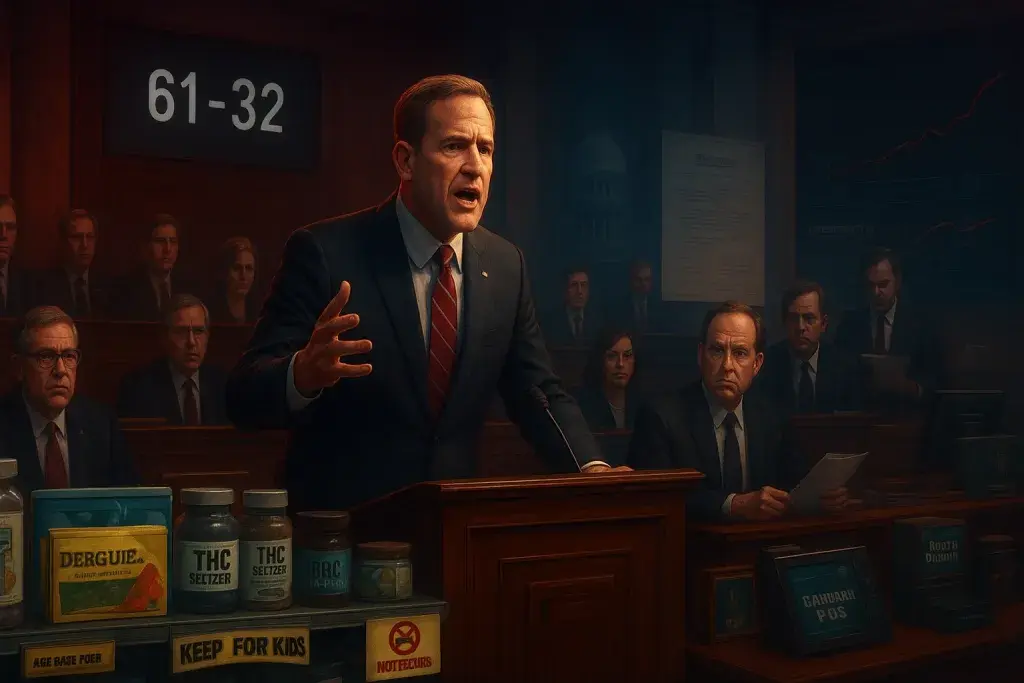
A one-month delay in federal hemp restrictions survived a Senate floor fight last week, leaving intoxicating hemp products on store shelves through Dec. 11 instead of the original Nov. 12 cutoff. Sen. Ted Budd, R-NC, tried to strip that delay out of the chamber's continuing resolution, arguing it protected an industry selling products marketed to kids. His amendment failed on a 61-32 tabling vote, with a coalition of 21 Republicans and 11 Democrats siding with him against the broader chamber.
The underlying fight traces back to a hemp law Congress passed in November 2025 that redefines hemp based on total THC content and bars finished products containing more than 0.4 milligrams of combined THC per container. That threshold, once it takes hold, will reshape wholesale menus nationwide - delta-8 gummies, THC seltzers, vape cartridges, and THCA flower largely fall outside the new definition. For operators trying to keep compliance logs and inventory systems current amid shifting thresholds, the back half of this story is operational as much as political: retailers in states building out regulated markets increasingly rely on point-of-sale infrastructure built for cannabis specifically, the kind of platform reflected in offerings like cannabis POS for North Dakota dispensaries, where SKU-level tracking and compliant labeling matter just as much as what's legal to sell.
That distinction - federal hemp policy versus state-licensed cannabis retail - is worth sitting with for a second. The 0.4-milligram threshold applies to hemp-derived consumables sold largely outside the licensed cannabis system, in convenience stores, gas stations, and grocery aisles rather than regulated dispensaries. But the compliance instincts are the same: batch tracking, COA verification, age-gated sales, and packaging that doesn't mimic candy brands. Operators watching this fight from licensed adult-use or medical markets should recognize the argument, even if the regulatory lane differs.
Why the Delay Mattered Enough to Fight Over
Budd's case rested on public-safety framing. He pointed to North Carolina emergency department data showing cannabis-coded visits among minors rising sharply since 2017, and argued that packaging designed to resemble familiar snack brands makes accidental exposure more likely. That's not a fringe concern in retail compliance circles - child-resistant, non-mimicking packaging has become a baseline expectation in regulated cannabis markets, and its absence in parts of the unregulated hemp trade is precisely what critics like Budd have seized on.
The opposing coalition - more than 100 organizations, including the US Hemp Roundtable, the National Association of Convenience Stores, and several North Carolina hemp and brewing groups - argued the extra 30 days gives Congress room to legislate real guardrails: good manufacturing practices, import restrictions on synthetic cannabinoids from China, and age verification requirements. In practice, though, a short delay rarely produces comprehensive regulation on its own. It buys time. Whether lawmakers use that time productively is a separate question entirely.
North Carolina's Parallel Standoff
The federal fight has a direct state-level mirror. House Bill 328 would write the same 0.4-milligram total THC limit into North Carolina law, effectively removing most intoxicating hemp products from store shelves regardless of what Congress ultimately decides. The Senate passed the conference report 37-6 back in July; the House has since declined to act, sending it back to the Rules Committee, where it sat when lawmakers left Raleigh.
Speaker Destin Hall's read on the standoff is telling: broad agreement that the current unregulated market can't continue, but no consensus on the fix. That's the same tension playing out in Washington - prohibition-by-THC-threshold versus a regulatory framework built around testing, labeling, and age limits. For hemp retailers and wholesalers operating near the North Carolina border, or anywhere state and federal timelines diverge, the practical risk is whiplash: a compliant SKU today could become unsellable inventory within weeks, with little room to unwind purchase orders or renegotiate wholesale pricing.
What Comes Next for Retailers and Suppliers
Neither the federal restrictions nor HB 328 have reached a final resolution, and the administration has signaled it won't seek another extension beyond December. That puts pressure on:
- Convenience and grocery retailers carrying intoxicating hemp SKUs, who face a hard compliance deadline with limited notice
- Hemp brands and co-packers reformulating products to meet the 0.4-milligram threshold before inventory becomes unsellable
- State lawmakers in North Carolina and elsewhere weighing whether to codify the federal standard or build separate regulatory frameworks
- Licensed cannabis operators watching to see whether tighter hemp rules shift consumer demand toward regulated dispensary channels
Fair enough to say the politics here are messy - a Republican senator at odds with a Republican White House, state legislators split along lines that don't track neatly with party. What's striking is how little clarity either side has actually delivered. Retailers, wholesalers, and compliance teams are left planning around a deadline that keeps sliding, in a market where the rules themselves remain unsettled.