
States Push Expanded PTSD Treatment Options for First Responders Beyond Standard Care
Authored by cannabiscanadabuzz.com, 22 Jul 2026
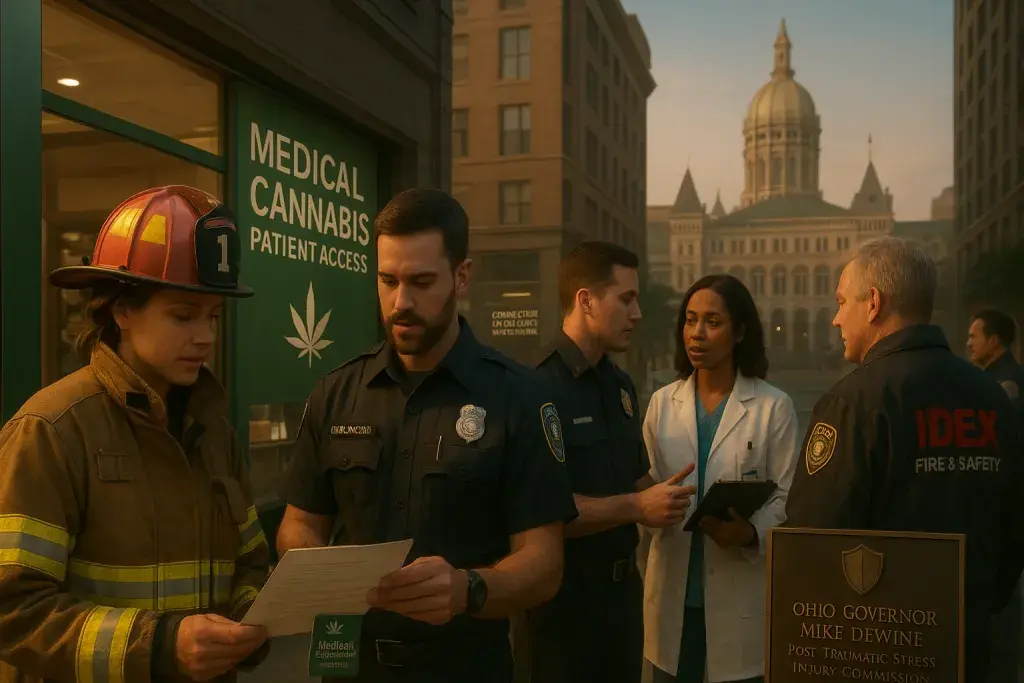
A quiet but significant policy shift is underway across several states, as legislatures move to broaden the mental health toolkit available to firefighters, police officers, and emergency medical workers dealing with post-traumatic stress. The approaches vary - from commission-based funding for treatment costs to employment protections for medical cannabis patients to regulated access to psychedelic-assisted therapies - but the direction is consistent: traditional counseling and medication alone are no longer considered sufficient by a growing number of lawmakers. For cannabis retailers, dispensary operators, and compliance professionals, at least one of these state-level moves carries direct operational relevance.
Maryland's approach is the most immediately actionable for the licensed cannabis industry. A new law, effective this October, extends employment discrimination protections to firefighters, EMTs, paramedics, and other rescue workers who are registered medical cannabis patients and test positive for cannabis metabolites - provided they are not impaired while on duty. That distinction matters enormously at the dispensary level. Operators who serve medical patients in regulated markets already deal with the compliance weight of verifying patient registration, maintaining accurate purchase records, and ensuring product is sold within legal limits. But this law signals that patient protection is expanding upstream from the dispensary floor into the workplace itself, which could affect how medical cannabis programs are positioned and how patient volumes in first responder communities shift over time. Dispensaries that serve significant numbers of medical patients - particularly in jurisdictions near fire stations, hospitals, or municipal facilities - may see category behavior change as workplace protections reduce the employment risk historically associated with registering as a medical patient. Tracking that kind of patient-side trend accurately requires robust data infrastructure; a well-configured IndicaOnline point-of-sale system, for example, gives operators the transaction-level visibility to identify shifts in patient demographics and purchasing patterns before they show up in quarterly revenue numbers.
The Maryland law does not require employers to accommodate impairment. That line - lawful off-duty use versus on-duty fitness - is the same one that defines the outer boundary of most state-level medical cannabis employment protections. In practice, though, that line creates compliance complexity. Employers in states with similar statutes have grappled with the absence of a reliable, real-time impairment test for cannabis metabolites. Metabolites can remain detectable in urine long after any psychoactive effect has passed. That biological reality is why Maryland's law specifically distinguishes between testing positive and being impaired. For dispensary compliance teams watching this space, it's worth understanding that these employment protection laws rarely touch how cannabis is sold - they don't change testing requirements, packaging, or purchase limits - but they do shape the social and professional risk calculus that determines whether eligible patients actually register and purchase through licensed channels.
Commission Model and the Ohio Angle
Ohio Gov. Mike DeWine's signing of legislation creating a Post-Traumatic Stress Injury Commission represents a different mechanism entirely. Rather than expanding the menu of treatments directly, Ohio is building a review and reimbursement structure - a body that evaluates applications from eligible first responders and helps cover treatment costs. What's striking here is that this type of commission model, if it ultimately recognizes medical cannabis as a reimbursable treatment for PTSD, could funnel new patients into Ohio's licensed dispensary network through an institutional pathway rather than individual patient initiative. That's speculative for now; the commission's scope and eligible treatments haven't been detailed in what's publicly available. But the structural logic matters for operators in adult-use and medical dual-licensed states: institutional recognition of a therapy tends to normalize patient pathways and reduce the stigma barrier that keeps eligible patients from entering licensed retail environments.
Psilocybin and Ibogaine - A Different Regulatory Track
Connecticut and Missouri are exploring psychedelic-assisted therapies - psilocybin in Connecticut, and both psilocybin and ibogaine in Missouri - under tightly supervised research frameworks. These are not cannabis-adjacent developments in any direct operational sense. Psilocybin and ibogaine remain federally controlled substances, and neither state has moved toward anything resembling commercial retail access. Connecticut's expanded pilot program at Yale is limited to clinical eligibility criteria set by an institutional review board. Missouri's bill advanced in the legislature but didn't reach the governor before the session ended in May.
Still, the cannabis industry has reason to pay attention. The regulatory framing being applied to psychedelic research - supervised clinical settings, patient eligibility criteria, state oversight bodies - closely mirrors the framework that early medical cannabis programs used in the 2000s and early 2010s. That trajectory is not destiny, but operators who remember how quickly medical programs shifted into adult-use commercial markets understand that research-phase policy often moves faster than its architects expect. Jason Cerrano, a retired firefighter and paramedic with more than 20 years in Missouri who now works in commercial research and development at IDEX Fire & Safety, described how cumulative trauma exposure in first responder careers creates psychological effects that build over time - the kind of sustained, compounding mental health burden that standard outpatient therapy has struggled to address at scale.
What Operators Should Actually Watch
The business implication across all of these state actions isn't about individual product sales. It's about patient access, social normalization of medical use, and the evolving regulatory definitions of what counts as legitimate treatment. For multi-state operators with medical cannabis licenses, employment protection laws like Maryland's represent a real expansion of the protected patient class. More registered patients, less employment-related deterrent - that shifts volume assumptions. For compliance teams, it raises questions about how dispensary staff are trained to discuss medical cannabis use in employment contexts, and whether patient-facing materials are calibrated to reflect current state law accurately.
The thing is, the cannabis industry has always existed in a policy environment that moves faster than standard retail. These first responder PTSD measures are a reminder that the patient base for medical cannabis is defined not just by health conditions but by the legal and social structures that make registration feel safe. When those structures change - as they are changing in Maryland, and potentially in other states watching these models - the dispensary market feels it, even if the mechanism is invisible at the point of sale.