
Georgia's Expanded Medical Cannabis Law Puts Augusta Dispensaries Back in Motion
Authored by cannabiscanadabuzz.com, 01 Jul 2026
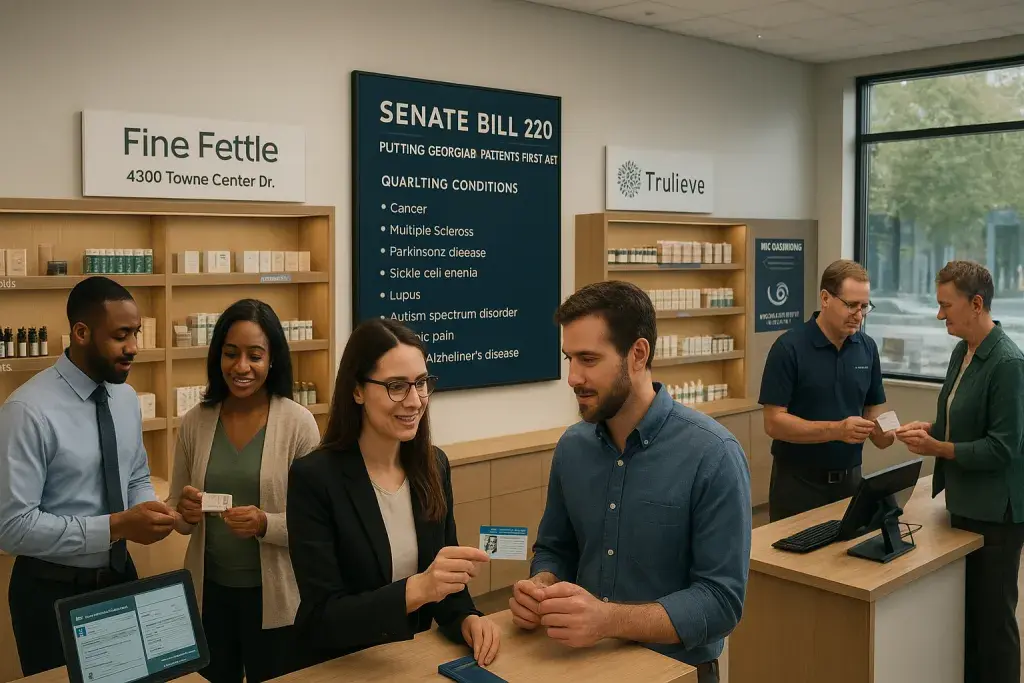
Two Augusta-area dispensaries opened their doors Wednesday under a materially different legal framework than existed just months ago. Senate Bill 220, the "Putting Georgia's Patients First Act," signed by Gov. Brian Kemp in May, expanded Georgia's medical cannabis program to include a broader range of qualifying conditions and, for the first time, permitted patients 21 and older to use vaporized THC products - not just oils. For licensed operators like Fine Fettle and Trulieve, that shift carries direct implications for product mix, patient volume, and how efficiently their retail operations can absorb the change.
Fine Fettle opened its Evans location at 4300 Towne Center Dr. on June 26, converting a former Pho Bac Vietnamese restaurant into compliant cannabis retail space - a buildout that requires everything from seed-to-sale tracking integration to ADA-compliant patient consultation areas. Trulieve, which now operates five Georgia stores, established its Evans footprint in September 2023 at 4218 Washington Road. Handling an expanded patient roster across multiple SKUs - oils, edibles, and now vape-compatible products - puts real pressure on inventory management and staff training. Dispensary operators running multi-location programs in tightly regulated states typically rely on purpose-built systems like IndicaOnline POS to manage compliant sales workflows, patient ID verification, and real-time product tracking across locations without creating compliance gaps at the register.
What's striking here is the scope of the eligibility expansion. The updated qualifying conditions list now includes cancer, multiple sclerosis, Parkinson's disease, sickle cell anemia, lupus, autism spectrum disorder, chronic pain, and severe Alzheimer's disease. That's a materially wider patient pool than most limited medical programs allow. In practice, though, broader eligibility doesn't automatically translate into higher transaction volume overnight - patients still must be certified by a physician who diagnoses a qualifying condition, and must register with the Georgia Department of Public Health. The program card, valid for two years, carries a $30 fee. Friction in the enrollment process can slow the pace at which expanded eligibility actually moves through a dispensary's POS terminal.
Product Permissions and Compliance Boundaries
Smoking cannabis remains prohibited under the new law. That's a meaningful distinction operators need to communicate clearly - both to staff and patients. What S.B. 220 does permit is vaporization of legal THC products for patients 21 and older, with a firm restriction against public use. From a compliance standpoint, budtenders need accurate training on this line, since misrepresenting what forms of consumption are lawful puts a license at risk. Compliant packaging and labeling must still reflect Georgia-specific requirements, and any product sold needs documentation tying it back to a licensed producer - certificates of analysis, batch records, and chain-of-custody documentation are non-negotiable in a state that runs a tightly controlled program.
What the Law Change Means for Operators Beyond Opening Day
The real operational question isn't whether dispensaries can open - they clearly can. It's whether their back-end infrastructure scales cleanly with a larger patient base and a more varied product catalog. Adding vape products alongside existing oils and edibles means updating wholesale menus, reviewing vendor agreements, and ensuring every product batch on the shelf carries the required state approvals. For multi-state operators like Trulieve, Georgia represents a small piece of a larger license portfolio, but in a state with a license cap and restricted retail geography, each location carries disproportionate weight. Fine Fettle, operating three Georgia stores, faces similar dynamics at smaller scale.
Local legislative support for S.B. 220 came from a bipartisan group of state senators - Lee Anderson, R-Grovetown; Harold Jones, D-Augusta; and Mark Newton, R-Augusta - which suggests political durability for the current program structure. That matters to operators weighing capital investment in physical retail space and build-out costs. A stable regulatory environment reduces the risk that a location converts to a liability; a volatile one makes every lease negotiation more complicated. For now, Georgia's program appears to be expanding methodically rather than lurching toward broad access - and for licensed operators already invested in compliance infrastructure, methodical is a workable pace.